It’s June and I’m in the early stages of a few different projects. This week I thought I had decided to really focus on my multi-POV middle grade manuscript. Alas, after a gut check, I realized that’s not where my energy is.
My true home base project seems to be the one I’ll call ZONE on this blog.
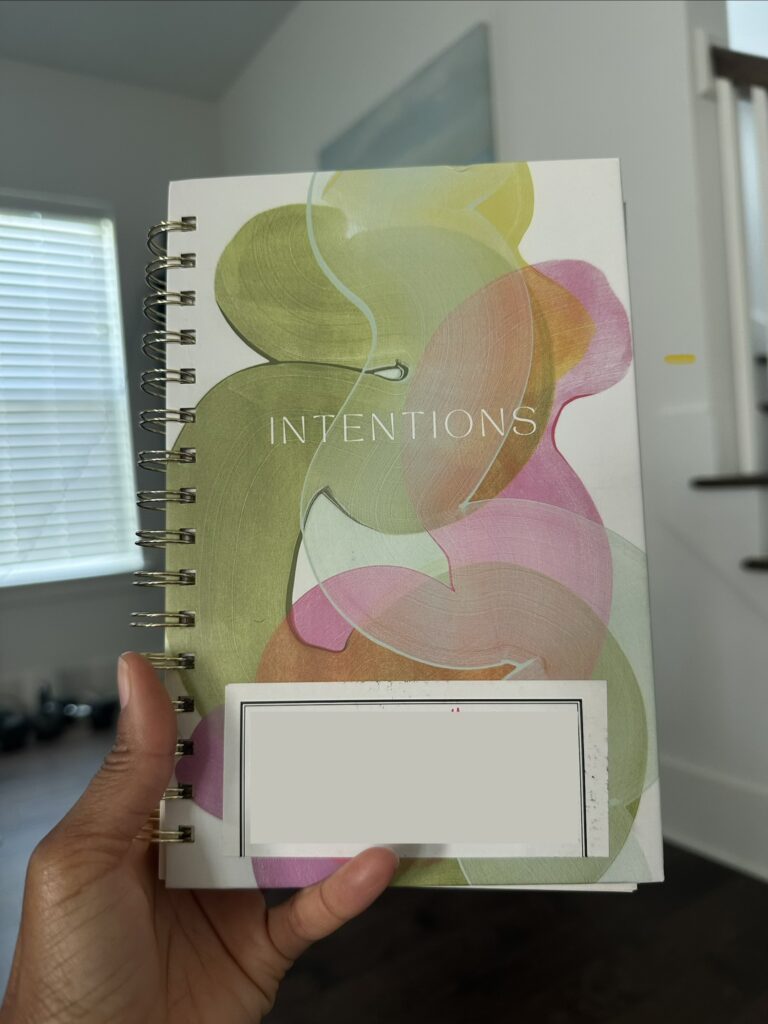
This is the notebook I started in 2024 for “ZONE.”
I’ve nurtured this idea since 2024. Since then, I’ve conceived, written and edited my fourth middle grade novel and a proposal for a fifth. But ZONE has waited patiently in the wings.
Truth is, ZONE challenges everything I know at this point. It’s not a middle grade. It’s not a prose novel. And it’s not a straight contemporary story. Instead, it’s a young adult, graphic novel, portal fantasy. If I can figure all three of those things out, we’ll have something!
It’s all a bit daunting. The world building and plotting it requires feels complex and overwhelming, even though the foundation it’s based on is “simple.” Until now I’ve only had the logline, some quick character sketches, and random snatches of ideas.
The last couple of days, I reminded myself that going from a vague idea to a finished project takes serious effort and many (many) small steps along the journey to completion. And really, when I’m not allowing fear to take over, I really enjoy the process of cultivating and growing ideas.
Over on PhYINomenal, Sojo’s self care focus for November is Elimination – time to release, remove, denounce, deny and let go. It’s a great time to release that which no longer serves you and invite in affirming energy, new processes, and transformative experiences.
If you’ve never checked out her site, today’s a great day to do it. Get the self care calendar for November and see what simple things you can do to release the deadweight and bring new life.
Over the years I’ve found myself in that place many times. One time in particular, I was stuck, stagnant and depleted. I needed something, anything, that could help me recharge my life and get inspired again.
I finally realized that I didn’t need to look outside myself for the answers. With patience and intention I could create them for myself. And I did. I spent several weeks enacting some simple practices, not unlike the suggestions Sojo recommends each month. And in short order, I found my joy once again.
I wrote about that experience shortly after it happened. I shared my story and my steps once or twice and then forgot about it. Earlier this year I sat down to dish with Sojo about templebuilding (listen here!), and it all came back to me. I even found the guide I drafted years ago and decided I’d put it out in the world. Eventually.
As it turns out, now is the time! I tried to convince myself to wait until next year, or next month, or next season. Later. But it’s always later. So if there’s one thing I’m working to release this month, it’s Resistance and his twin sister, Procrastination.
As a 42-year old woman who has lost both parents (momma 13 years ago and daddy 10 years next month), I know for sure that time waits for no one and tomorrow is not promised.
I’m not expecting my work to reach a million people, but I do hope it can create value in the life of at least one. If you’re looking to revive your inner beauty, and do it your own way, consider using my guide as companion in your walk. It’s available here.
Let me know how you tap into your creativity and create your next victory.
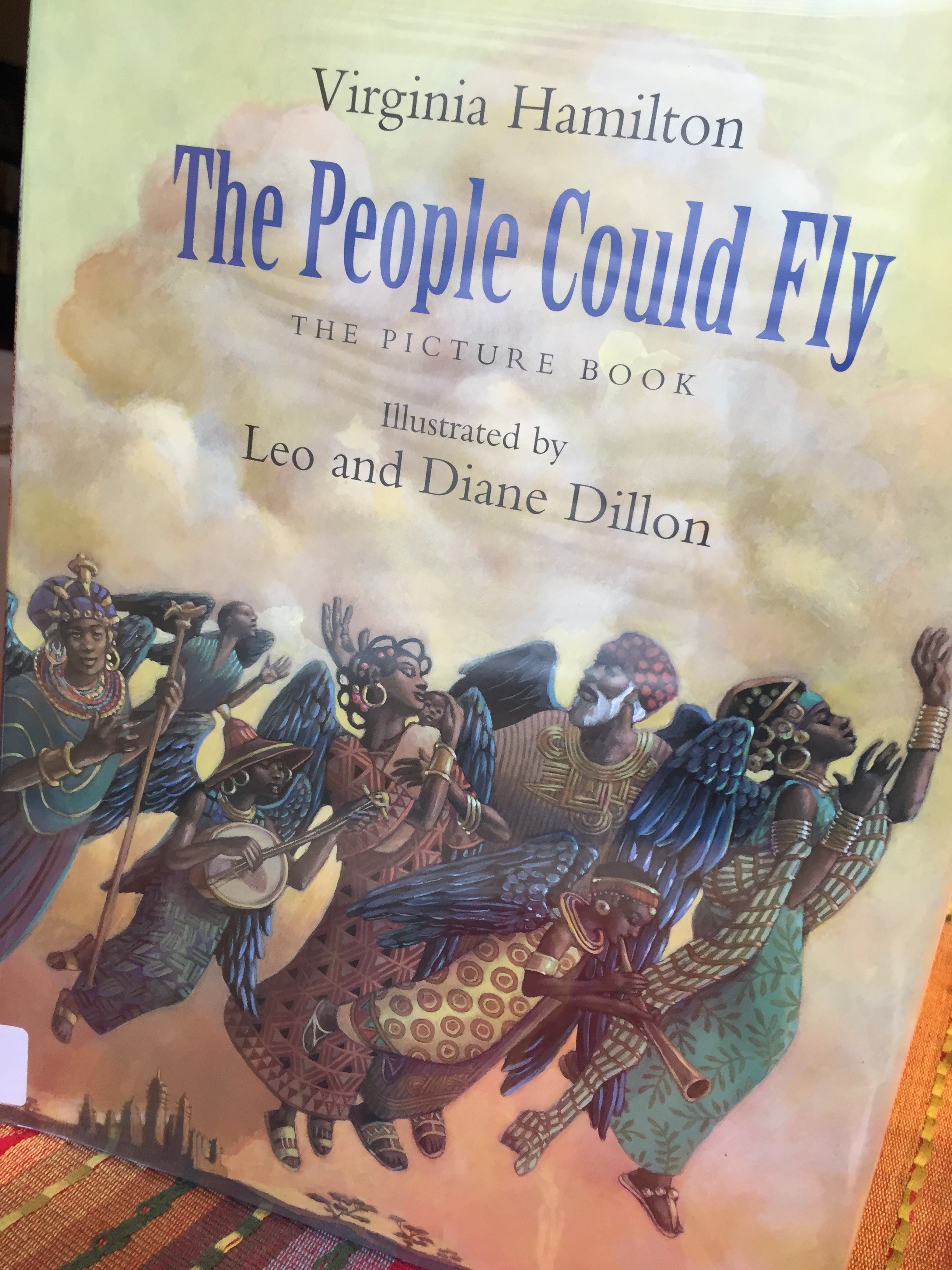
On a recent visit to the public library, The People Could Fly jumped off the shelf and into my hands. I knew the author, Virginia Hamilton, and the title was familiar, but one I’d not yet read.
It demanded to come home with me.
It did.
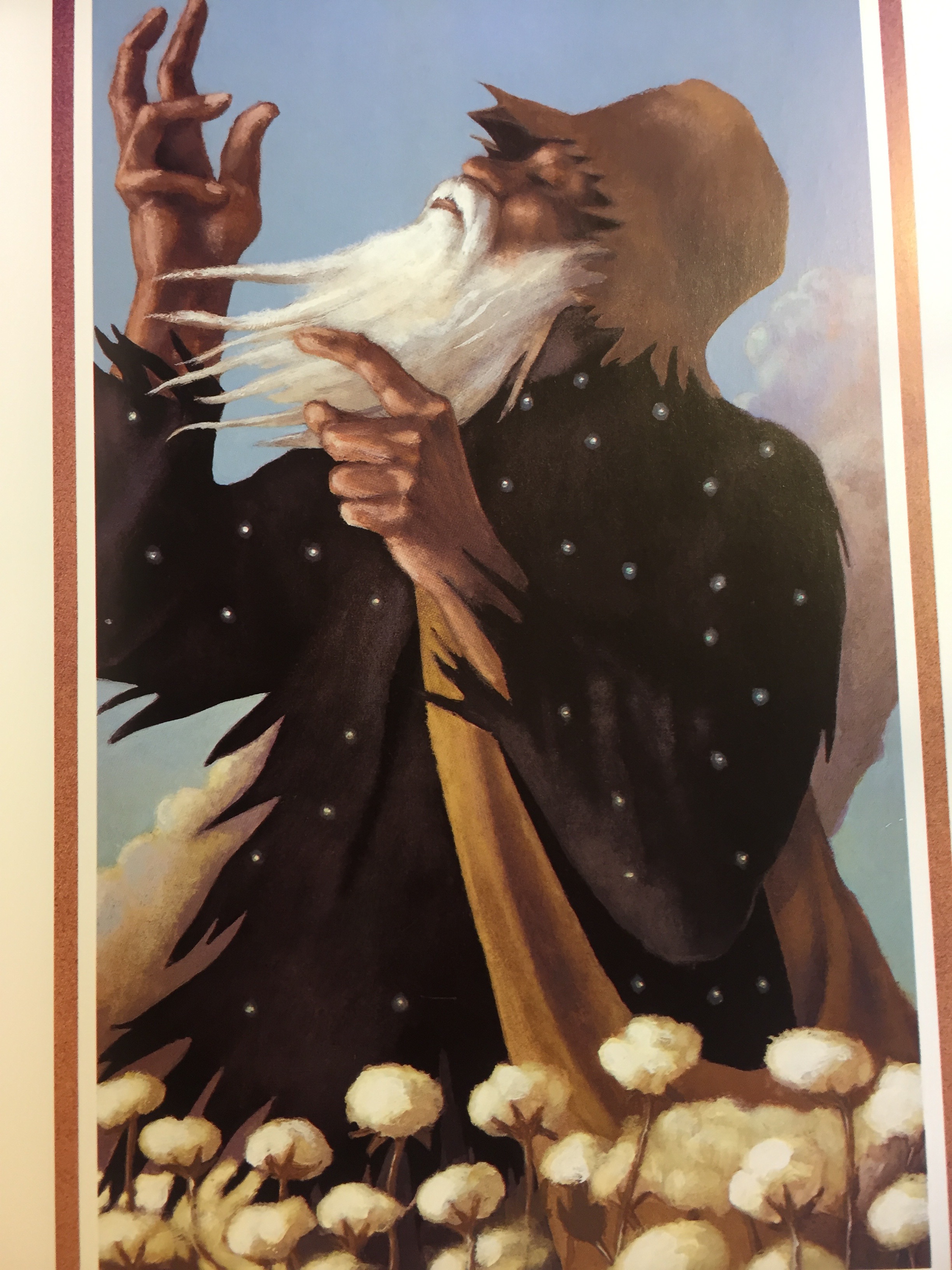
Today I cracked it open and was struck. The pictures and storytelling moved me. So much so I could see it – as dance. I could see the brilliant bodies of Alvin Ailey American Dance Theater making these pictures. And flying.
Revelations is my favorite thing. This would give it a run for the money.
I’m currently adapting a children’s book into a play. But if I were born with different talents, I would adapt this for dance. If you have this talent, I invite you to interpret this piece for the world. It’s Black people dancing pain. Then dancing magic, freedom. Flying away.
This work moves me because I’m interested in helping adults tap into their imagination. I believe many problems in society are due to lack of imagination. Too many don’t believe in the possibilities of change. They think the way things are is the way they’ve always been, and subsequently, have to be.
But if you are imaginative, you know better.
We need more art in the world that forces people to reckon with possibility.
Friday seemed quite a distance from Saturday afternoon, but here we are already.
Today was the closing session of the Aspen Seminar. We discussed our final round of readings, including my second favorite of the week, In our Postmodern World, a Search for Self-Transcendence by Vaclav Havel.
After our discussions, we wrote a letter to ourselves that we can expect to receive six months hence. We wrapped up with personal reflections and thank yous, and one last lunch together.
My thoughts during the week were enhanced by the many voices in the seminar. Ultimately, however, I came to believe that my initial thinking on many things is the right way to proceed:
I believe in the inherent goodness of humans.
I believe society is never fixed and final. Similarly, humans are dynamic. As leaders it’s important to reflect, evolve and grow with intention.
It’s important for humans to resist urges toward greed and ego, and to remember the ways in which we are interconnected.
All change and forward motion begins when you lead from within.
I will lead through art.
I’m notoriously bad with goodbyes, and it was a bittersweet ending. I was in the company of brilliant minds, and even though it was an immense challenge, I’m proud I rose to the occasion and grateful for the opportunity.
The theme of the day was leadership, and our readings included pieces by Machiavelli, Confucius and Plato to name a few.
Perhaps the highlight of the day was our late afternoon performance of Antigone.
Apparently it’s a tradition that participants perform the play during each seminar. But here’s the thing: you don’t have to play it straight. In fact, you’re encouraged to interpret the themes and retell the story in a novel way.
I don’t mind saying that ours was a wonderfully creative, collaborative success. We set the play in the 21st century, narrated through the lens of Nancy Grace. It was a funny, modern take. Our moderators and the seminar coordinator were our primary audience and a great time was had by all.
Afterward, we debriefed our choices and the key ideas from the original play. We wondered what Creon could have done differently. Was Antigone principled or simply hot-headed? What, if anything, could’ve altered the course of events? Have we ever been Creon? How did we deal with an Antigone in our respective organizations?
These questions can apply to use as business or education leaders, or as leaders in our own families and communities. I think the important thing for leaders always comes back to reflection and evolution. You may not make the right decision in a given moment, but how can you learn from your actions and take another step forward?
I’m pretty convinced I won’t do today’s session justice. Partially because it’s getting late and I lose brain cells once the sun goes down, and partially because we had a double session today.
We began at 8:30 a.m. as usual. Our morning focus was equality and social welfare. We dissected some pretty powerful pieces including The Communist Manifesto, The Second Sex, and far and away my favorite of the series, MLK’s Letter from Birmingham City Jail.
Notably today also featured poetry, fiction and writings from women. The latter had been sorely lacking and frustrated me during my preparations last month. I appreciate reading texts from the canon, and I think there are ways to pair “classic” texts with more modern viewpoints.
But I digress.
Our discussion of Simone de Beauvoir’s piece, The Second Sex, was a pivotal one, as it was our first woman author and she was unapologetic in her stance. Our group is an amazingly diverse one, and the women especially represent a wide cross section of view points. Two things stood out to me in her piece. One was her discussion of “freedom of maternity.” I find that brilliant phrasing and it engendered quite a few comments. The other was her discussion of woman finding herself:
What woman essentially lacks today for doing great things is forgetfulness of herself; but to forget oneself it is first of all necessary to be firmly assured that now and for the future one has found oneself. Newly come into the world of men, poorly seconded by them, woman is still too busily occupied to search for herself.
Once we concluded that piece, we moved into into MLK’s powerful yet less well known masterpiece. It’s a brilliant document in many regards, but my favorite sections were his rationale for the Negro’s legitimate and avoidable impatience, and his profound disappointment with the white moderate. Wrote MLK:
Frankly, I have never yet engaged in a direct action movement that was "well timed" according to the timetable of those who have not suffered unduly from the disease of segregation. For years now I have heard the word "Wait!" It rings in the ear of every Negro with a piercing familiarity. This "Wait" has almost always meant "Never."
<and>
All that is said here grows out of a tragic misconception of time that will inevitably cure all ills. Actually time is neutral. It can be used either destructively or constructively. I am coming to feel that the people of ill will have used time much more effectively than the people of good will.
The work is parts rebuttal, documentation, poetry and provocation. If you’ve lived this long and have never read it, now is the time.
After lunch and a short break, we reconvened. The afternoon’s session on community included a poem, The Moose, which at first held little to no meaning for most of us. Through dialogue and reflection we unlocked the deeper meaning and then joked there would be a moose outside waiting for us at the end of our session.
As luck would have it, no moose were nearby, but we did (rather unexpectedly) see a family of elk! In the poem, a moose appears from the woods and inspires joy and wonderment. In real life, the elk did the same.
I spy a family of elk!
We closed the evening with fellowship and dinner.
And such was the beginning of the end of our time. Tomorrow is our last full day. Friday, we meet once more, dine and away.
The past couple of days and today especially, my thoughts have turned to the three poisons. They are a subject of daily inquiry as I reflect upon what is good and how to create more of it in society.
In Nichiren Buddhism, the three poisons are greed, anger and foolishness. In brief, greed is the desire for excess – more than one’s share, to the detriment of others. Anger is grounded in ego. It’s the distorted belief (and behavior) that one is better than others, and is often brought on by lack of self-confidence. Foolishness is ignorance of the true nature of oneself. It’s unawareness or disbelief in the potential for enlightenment.
I believe all of what ails society can be traced to one or more of these poisons. Today’s session was on property and efficiency, and featured writings from Plato, Locke, Khaldūn and Bolívar. For various reasons, Bolívar’s Angostura Address was the most impactful for me. Two lines from his fiery speech:
Hence, legislators, your task is all the more difficult in that you have to reform men perverted by the illusions of error and unhealthy desire. <and>
…purify the corrupted aspects of our republic, denouncing ingratitude, selfishness, coldness of affection for the country, idleness and negligence on the part of citizens, and condemn the causes of corruption and pernicious examples...
In both cases I see the three poisons alluded to as corrupting influences. He seeks to provide an antidote through the reformation of government.
The seminar method of discussing these texts is an interesting one. Each of the participants pulls out very different things as inspiring, or problematic or food for thought. Our constant task is to make sense of what we’re reading and discern the lessons for leadership locked within.
Tomorrow we continue with a double session. More to come.
Today’s readings investigated individual rights and liberty. We had two sessions – one in the morning and one in the evening. In the morning we tackled Aristotle, Rousseau, Sumner and the Declaration of Independence.
We discussed the Aristotelian notions of place in society, including the positionality of slaves and masters. We wondered what Rousseau meant by free when he wrote of forcing a man to be free who refuses to obey the general will. We debated the merits of the Declaration of Independence, from the use of the language to its call to action. We closed with The Challenge of Facts, a clearly written document that, among other things, seems to indulge in victim blaming.
I like the ways the facilitators ask framing questions. What would Hobbs say about this? What might Aristotle say to that? These sorts of questions challenge us to reconsider old understandings and bridge the new ones.
After some down time, we ventured up the mountain to a cabin called Toklat. There we enjoyed a discussion of Melville’s Billy Budd, closing the night wondering what Captain Vere could’ve or should’ve done differently. It’s an interesting exercise to imagine how we’d be better or different leaders under similar circumstances. I think that’s the key, really. The ability to imagine different outcomes keeps us youthful and agile.
And so concludes the first full day of the Aspen Seminar. I’ve done a few group events over the years, but this one is the first one where such significant bonding occurs so quickly. We’ve had a few meals together and several hours of pointed conversation, and that’s been enough for individuals to connect while the whole group creates its own personality. It’s fascinating really.
The view from breakfast.
Today’s session was on human nature. Our readings included Aristotle, Hobbs and Darwin. We discussed each text to understand what the authors said, whether or not we agree with their argument, and how we can apply the text to our leadership contexts.
At one point I talked about the importance of cultivating the potential inherent in each individual. My point echoed a key idea in Nichiren’s cherry, plum, peach, damson teaching. In brief, each plant is valuable in its own right, and need not strive to mask its uniqueness nor work to be like another plant in order to reach its full potential.
Our inquiry was essentially: what is the inherent quality of humans? Before a corrupting influence, who are we and how do we behave? The essence of the oak tree is contained within the acorn. An acorn is never going to be something else other than an oak tree, although circumstances can prevent it from growing or hamper it from reaching its full potential.
Your leadership style rests in part on what you believe to be true about human nature. Like Mencius, I believe humans are inherently good. The leader’s role, then, is recognizing the potential we each have, and cultivating it. Of course not everyone agrees with this, and again it’s the disagreement that makes the Conversation worthy to take place.
We just concluded the opening session of the seminar. We’ll be here another six days so there’s a lot in store. There are many brilliant thinkers here, and it’s going to be a challenge for me to step out of my listening stance to speak more. A lot of good insights arose in a very short time, and I can see how these readings and discussions will build on each other throughout the week.
We have two capable moderators in Jerald and David. Jerald led the opening reception and introductions while David facilitated the opening discussion. Although I’m not at liberty to report on who said what, I do want to share the question which framed our talk this evening: Why do people disagree? It’s a great question, and one which can frame many conversations across a range of topics.
True dialogue, which is not about debate or persuasion, but about understanding, gets at the heart of this. When you endeavor to dialogue with another, you work to peel away layers. To reveal values. To listen. To learn.
Sometimes you find that disagreements are based on different life experiences or values, language barriers or misunderstandings. In some cases, the disagreements might be quite minor and consensus close at hand. In the others, especially in the case of values, disagreement might be profound, with seemingly no resolution forthcoming.
As the eternal optimist, I believe that even in the case of divergent values, there is room for empathy and compassion. Across large institutions, governments, societies, groups can still find some common ground.
Our discussion was on An Agreement of the People. We spoke specifically about politics and civil law, power and property, but my mind was most interested in the idea of insider/outsider status.
How do we identify other insiders?
How do we treat outsiders and (how) can they come to be invited in?
What is the role of trust in the insider/outsider relationship?
If you extend trust to those on the outside, do you, in that very act, bring them inside?
Tomorrow is Session I: Human Nature. I had trouble with some of the readings because I disagreed with some of the fundamental arguments the authors presented. We don’t have to agree to contribute to the Great Conversation. And really, disagreement is what makes the Conversation worthy of having.